I never expected a stack of foundations and a staircase to turn me into a walking catapult. Yet there I was, soaring out of my Palworld base like a seed from a dandelion puff, all because I built a ramp that exploited a hidden momentum mechanic. In 2026, two years after the game’s explosive debut, Palworld still cradles secrets the tutorial never whispers—and this DIY launchpad is one of the most liberating.

I discovered the trick on a rainy Saturday, stuck in the early zones of the Palpagos Islands with a base that felt more like a prison than a home. Like many survivors stranded in a hostile paradise, I had read about glitches—the Pal Sphere glitch already let me cheese short-distance travel—but I craved something more organic, something that felt like bending the world’s physics rather than breaking them. Then I remembered a fleeting forum comment: running downhill builds momentum. It isn’t shown in any UI bar, but if you hold that sprint key while descending a slope, your character starts to slide as if lubricated by melted butter. That slide translates into a burst of speed that flings you forward the moment the ground levels out.
The problem was obvious. Hills are nature’s mood; they don’t always cooperate with my spawn point. Why not grow my own hill? Palworld’s building system is a box of fractal Legos—each piece snaps to another with a satisfying click, and the vertical limit stretches high enough to tickle the clouds. So I laid a foundation, raised a wall, and attached a staircase angled upward. Then I repeated the process beneath it, constructing a skeletal spine of walls and foundations that pushed the ramp higher, like building a ski jump out of plywood and hope. Within thirty minutes I had a structure that pierced the tree line, a grey tongue licking at the sky.
What happened next felt like discovering a secret handshake with the avatar’s code. I stood at the foot of the ramp, broke into a sprint downward, and my character whooshed down the incline as if wearing skates on a frozen waterfall. By the time I hit the bottom edge, the stored momentum launched me over my base wall, past the berry plantations, and into a glide that covered half a biome. My mouth tasted the same metallic surprise you get when a firework goes off unexpectedly close—a visceral blend of danger and delight. I had turned myself into a human mortar shell, and the shell was me.
The construction itself was idiot-proof, which is saying something in a survival game where a misplaced roof tile can summon a cascade of structural errors. Here’s the recipe I followed, one that works whether you’re on a private server or crouching in a single-player corner:
🧱 The Ramp Recipe
-
Place a Foundation on reasonably flat ground. This anchors the whole beast.
-
Snap a Wall onto the edge closest to the direction you want to launch. The wall becomes the ramp’s spine.
-
Attach a Staircase to the top of that wall, angled downward toward your launch direction. You might need to rotate the staircase until the step surfaces form a smooth slide.
-
Extend the skeleton by adding more walls and foundations underneath the staircase. This lets you raise the ramp’s peak without the structure crumbling. Climb up, place a new wall, and let the next staircase snap to it.
-
Repeat until you’ve built a ramp high enough to make your stomach drop. I stopped at around 25 wall segments—roughly 70 meters—but the engine allows over 200 pieces vertically if you have the patience of a saint cultivating a bonsai.
Once the ramp exists, there is a ritual to using it. Sprint toward the top, then immediately turn and sprint down the slope. Don’t jump; let the slide acceleration kick in, and right before you hit the flat foundation, release the sprint key to preserve your momentum into an airborne glide. Paired with a low-stamina glider pal like a Nitewing, the distance you cover feels almost like fast travel. My early-game exploration became a series of parabolic arcs, each launch a tiny rebellion against the map’s deliberate sprawl.
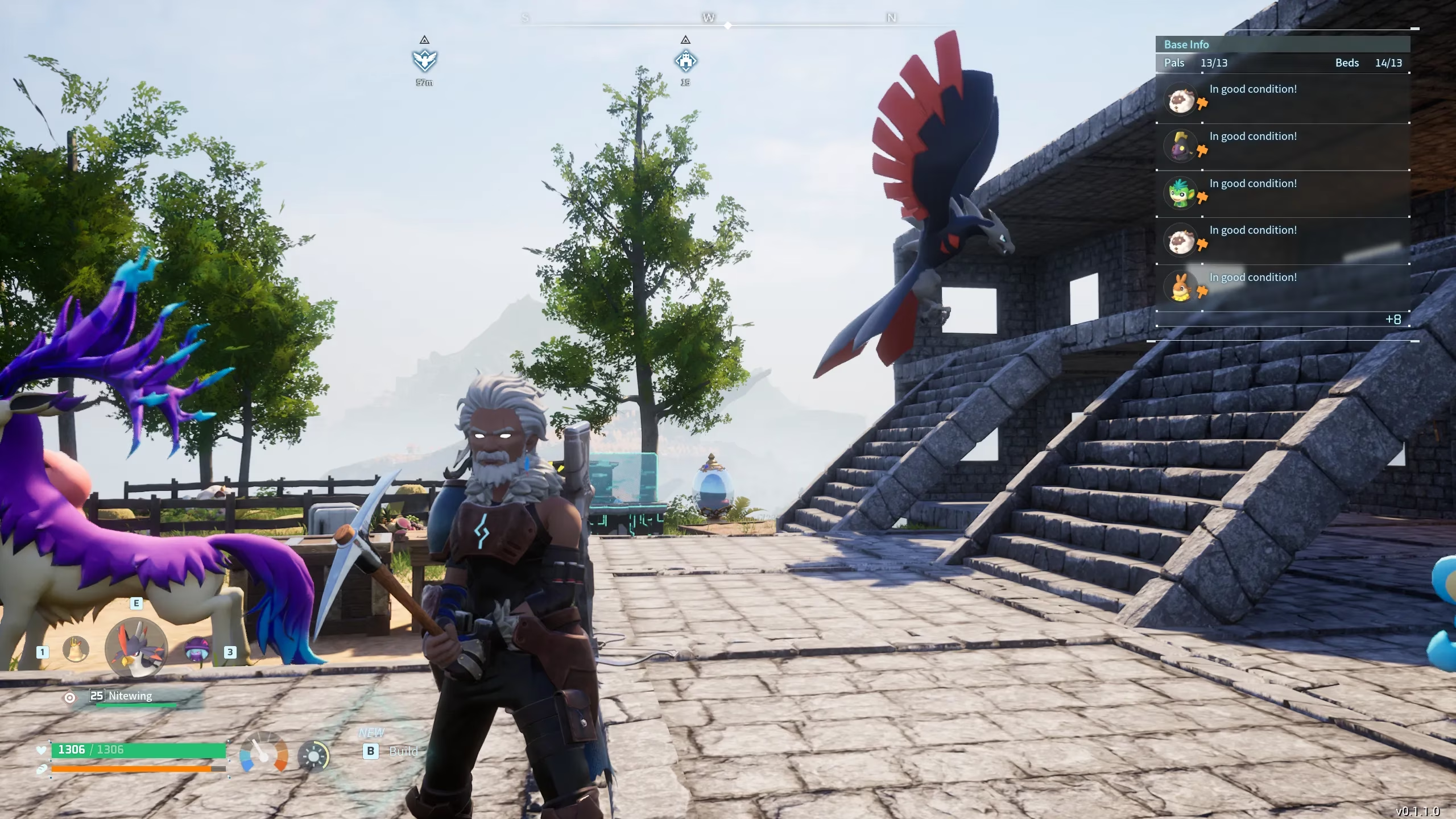
This ramp trick reminded me why Palworld, even in 2026, still outpaces many soulless survival clones. It borrows DNA from genre ancestors like Ark: Survival Evolved, but where those games often punish creativity with rigid physics, Palworld acts more like a chemistry set. The building system is a set of elemental reactions—wood, stone, human greed for height—and the momentum slide is the catalyst nobody reads about on the ingredients label. You can place these ramps outside your base perimeter too, though they’ll slowly decay like a sandcastle at high tide unless you’re willing to repair them. I found that dropping a temporary ramp near an unmapped volcano gave me a free balcony view of an entire region without taming a flying mount.
The community reaction has been a slow burn. Most players still rush toward the Direwolf saddle or a flying Pal, but I’ve started seeing more launch ramps sprouting on shared servers, especially around starter zones where a low-resource boost matters most. It’s the kind of emergent behavior that makes a game’s subreddit glow—a shared secret that isn’t a bug, but a gentle exploitation of intended mechanics. One player even built a ramp that doubles as a watchtower, dubbing it “The Eyrie’s Springboard.” I just call it my morning commute.
Of course, there’s a metaphorical layer here that I can’t ignore. Building a ramp in Palworld is like weaving a net out of moonbeams: the tools are mundane, the outcome feels magical. You’re constructing a physical ladder to a flight you haven’t earned yet, bending the rulebook until it hums. In a title where pals can be overworked, butchered, or turned into slave labor, this harmless momentum trick is a rare moment of pure, unadulterated fun—a reminder that the best survival games are those where the players, not the developers, write the final instruction manuals.
So next time you log in and stare at the horizon from your shoddy wooden base, don’t grind for an faster mount. Spend ten minutes gathering stone and wood, and build yourself a ramp. Become the slingshot projectile. The islands are bigger than they seem, but your new cannon says distance is just a suggestion.
Exploring these hidden mechanics and discovering unique gameplay elements is part of what makes gaming so rewarding. But sometimes, the thrill of the game is also about finding the best deals on the titles you love. Whether you're looking to dive into Palworld or expand your collection with similar games, staying informed about pricing can be a game-changer. For those keen on keeping their gaming budget in check, a game price tracker can be an invaluable tool. It helps you monitor price drops and special offers, ensuring you never miss out on a great deal.
As you continue to enjoy the creative exploits and emergent gameplay of your favorite titles, having a resource like DealNest at your fingertips can make the experience even more satisfying. It allows you to focus more on building those ramps and exploring vast digital landscapes, knowing you're getting the most value for your gaming investments. So, next time you embark on a new adventure in the world of gaming, consider using such tools to enhance your journey and keep your wallet happy.
Loading comments...